Breakthrough for high-quality recycling in construction
26 May 2026
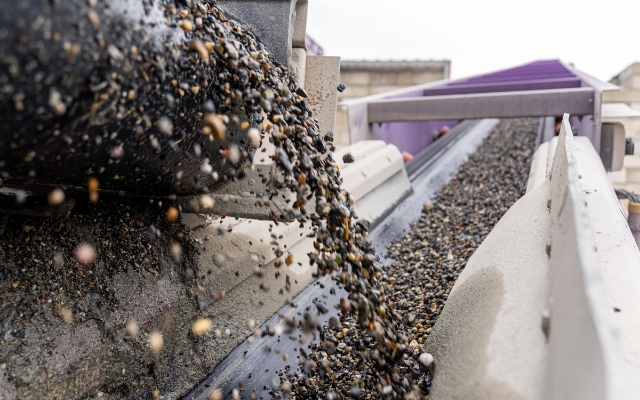
New procurement and purchasing guidelines within the Dutch Concrete Agreement mark an important step in making the construction sector more sustainable. They enable clear requirements for reuse and high-quality processing of concrete and steel to be systematically incorporated into tenders. For the first time, an approach that links circular demolition, high-quality processing and reuse has been embedded across the chain in procurement. This shifts circularity from ambition to reality.
Circularity starts at demolition. Circular demolition means that materials released are removed and separated in such a way that they can be reused at a high level of quality. By then explicitly requesting these recycled materials in new projects, the loop is effectively closed.
The guidelines have been developed through a broad collaboration of public and private clients and have now been formally captured within the Concrete Agreement for the first time. They provide clients with a concrete framework to structurally incorporate circularity into procurement and thereby drive the market forward.
Renewi approach as a benchmark
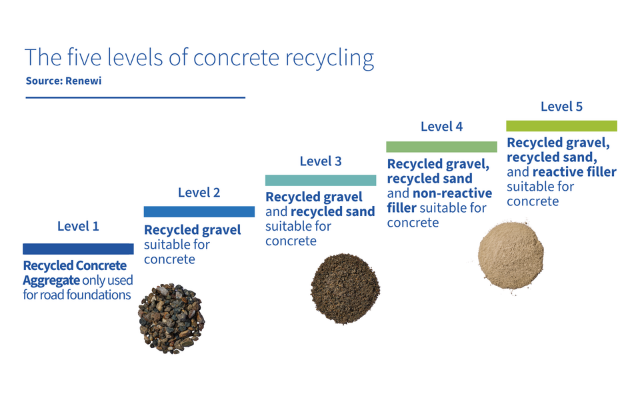
The new guidelines show a clear hierarchy, based on the five levels of value creation developed and applied by waste‑to‑product company Renewi. Level 1 is the lowest level: using crushed concrete as road base. In the Netherlands, a large share of concrete rubble is still applied in this low-grade way, which is considered downcycling.
Level 5 represents the highest-quality, fully circular form of concrete recycling, where gravel, sand and reactive filler are processed back into materials suitable for use in new concrete. These five levels of concrete recycling are now used by the Concrete Agreement as a practical guide for clients.
Professor Jacqueline Cramer, Chair of the Dutch Concrete Agreement: “We deliberately chose a hierarchy of applications in the procurement guidelines, based on five levels of value creation developed by Renewi. This makes our understanding of circularity tangible and provides clear direction for both clients and market parties.”
From pilots to scale
The new guidelines build on practical experience from earlier projects. A key example is Rijkswaterstaat’s A9 project, where, together with partners including Renewi, work was carried out to return released concrete rubble to Rijkswaterstaat projects at a high level of quality.
The A9 project demonstrates that circular solutions are technically and logistically feasible, but also that scaling up depends on consistent demand from clients.
Jan‑Pedro Vis, Director Materials at Renewi: “This is a major breakthrough. When clients explicitly steer towards the highest forms of reuse and recycling, a structural demand for high-quality applications emerges. That is exactly what is needed to scale up circularity in construction.”
Consistent demand as a catalyst
With the introduction of uniform guidelines, a widely applicable framework is established for the first time, enabling clients to incorporate their demand into tenders and drive the market. This approach is expected to gain broader adoption in the coming years and help achieve the ambition of recycling at least 82% of Dutch waste by 2035, of which 15% should be high-quality recycling.
Globally, the construction sector is responsible for 34% of raw material use. These resources are finite. At the same time, geopolitical developments are putting pressure on prices and increasing the importance of a more independent supply of raw materials. A circular economy, in which materials are structurally reused and recycled, offers a concrete and scalable alternative.