This page is also available in Dutch.
CO2 Performance ladder at Renewi
Renewi is certified under the CO₂ Performance Ladder. We are preparing for the transition to Handbook 4.0, and aiming for achievement of step 2. This level best aligns with Renewi's current certification level 4 under the previous handbook guidelines. The CO₂ Performance Ladder is managed by the Foundation for Climate-Friendly Procurement & Entrepreneurship (SKAO). Renewi uses this instrument as a tool for reducing greenhouse gas emissions in its own operations, in CO₂ Performance Ladder projects and in its value chain.
On this page, we share our CO₂ emissions, targets, measures, progress and improvement points. We update this information as part of our CO₂ Performance Ladder communication approach.
FY26 update: where we stand
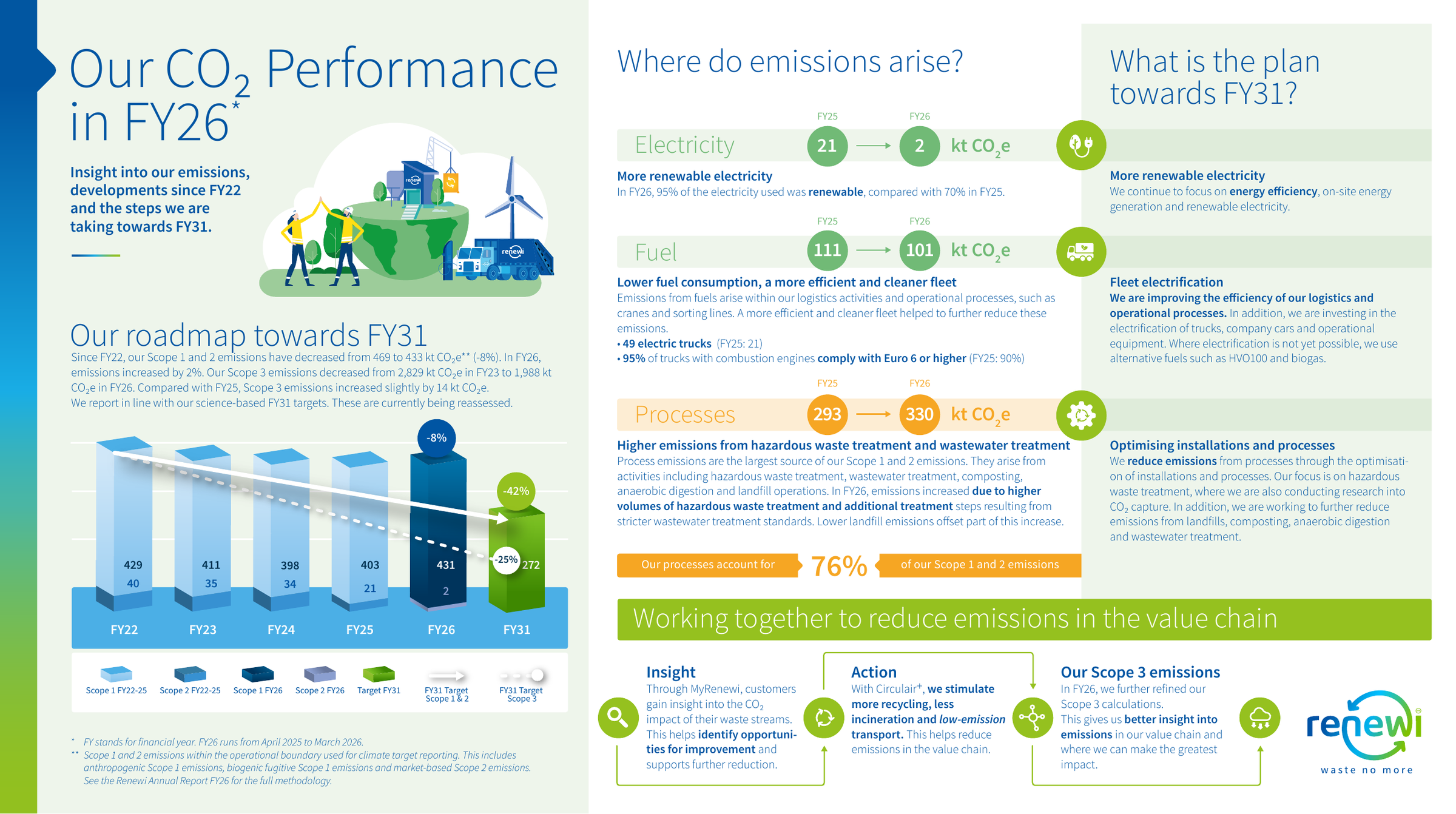
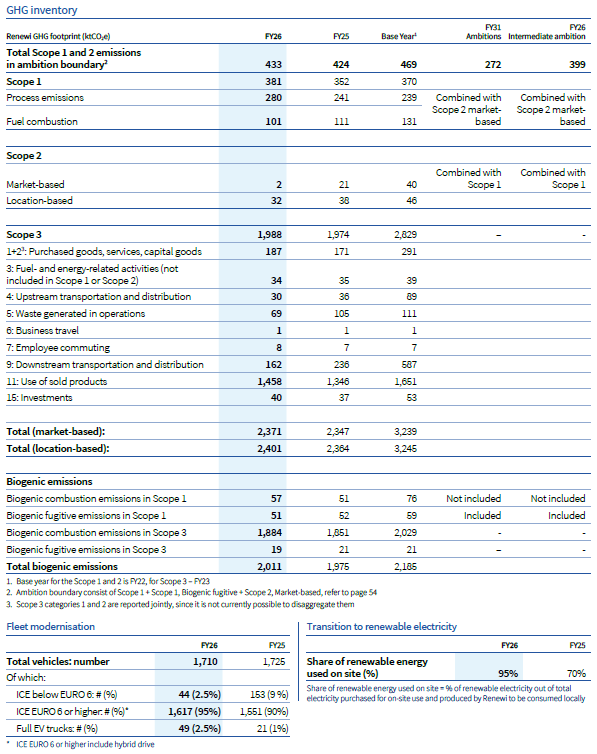
In FY26, Renewi’s Scope 1 and 2 emissions were 433 kilotonnes CO₂e. This is 2% higher than in FY25.
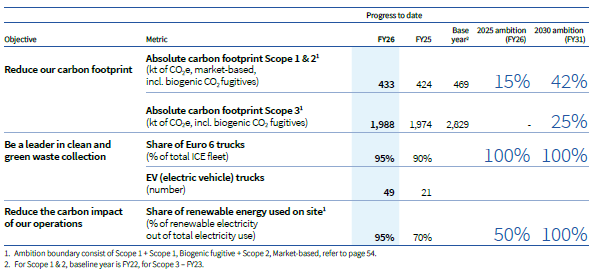
This increase was mainly caused by higher Scope 1 process emissions, linked to higher hazardous waste volumes and stricter wastewater standards. Emissions from fuel combustion decreased. Scope 2 emissions decreased significantly due to the use of renewable electricity within Commercial Waste. Although various initiatives reduced emissions from collection and energy use, these reductions were not enough to offset the increase in process emissions.
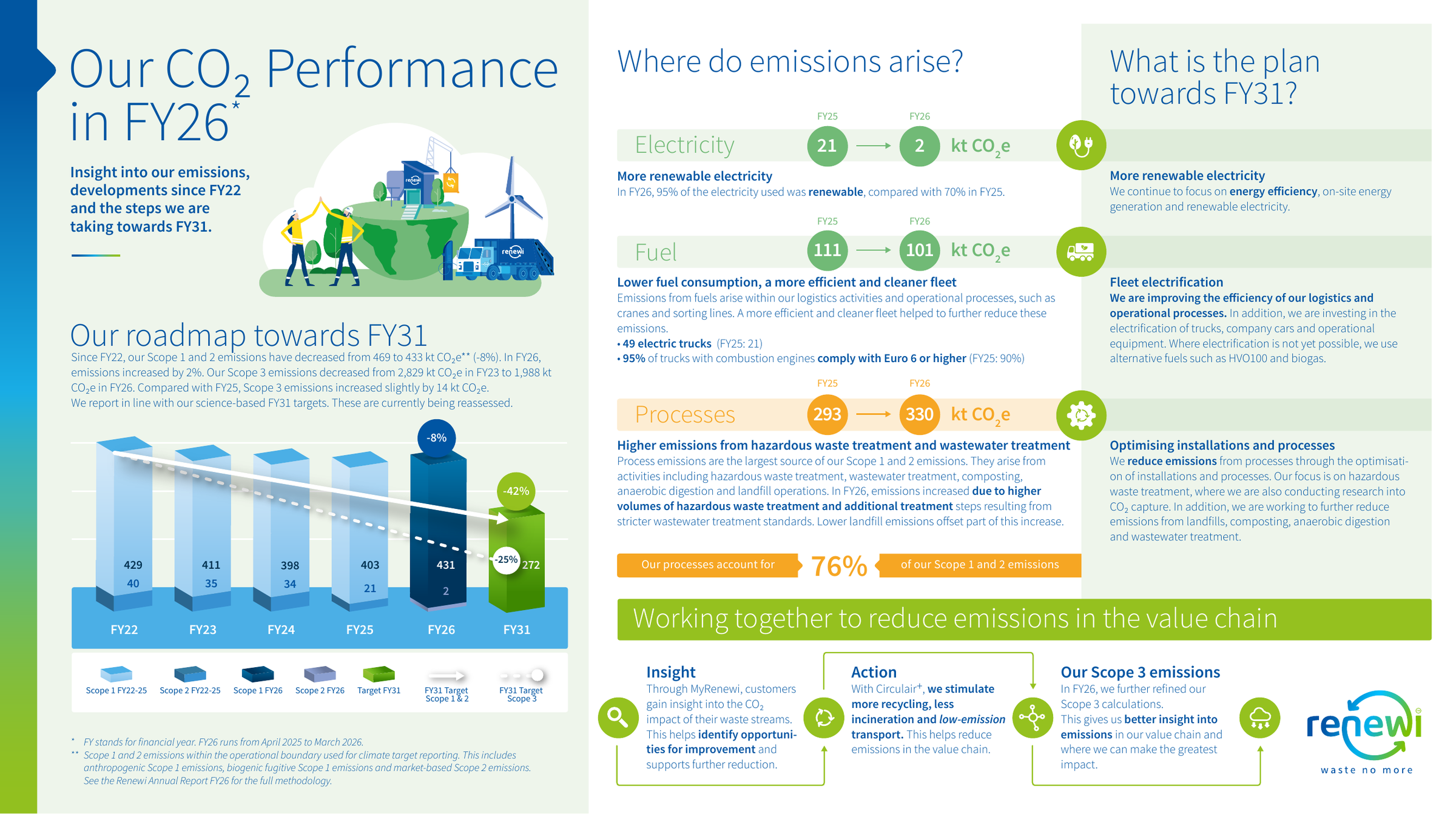
These results show that CO₂ reduction in an operational company is not always a consistent downward trend. Volumes, waste streams, regulation and treatment routes all influence our emissions. That is why we continue to measure, explain and adjust our approach.
We use these insights to steer where Renewi can have direct influence: energy use, transport, treatment processes, waste separation, data quality and cooperation with customers and value chain partners.
Our goals and reduction route
Renewi remains committed to reducing CO₂ emissions in line with the objectives of the Paris Climate Agreement and the CO₂ Performance Ladder. The targets communicated earlier remain in place:
- Reduce Scope 1 and 2 emissions by 42% by FY31 compared with base year FY22.
- Reduce Scope 3 emissions by 25% by FY31 compared with base year FY23.
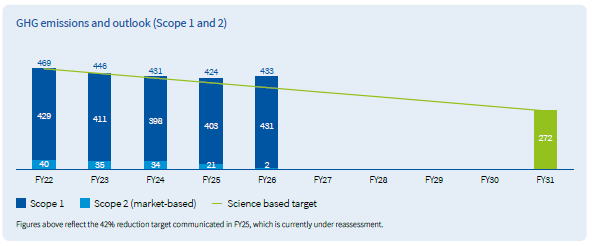
Renewi is reviewing the route, assumptions, data, measures and planning behind these targets. This review is needed because insights, data and circumstances have changed. This includes developments in external frameworks, a more complete Scope 3 calculation and changes in ownership, Board and Executive Leadership Team.
Renewi will publish the updated reduction route after internal review and approval. During this review, we continue to work on measures that already contribute to lower emissions and more circularity. These include energy savings, transitioning to renewable energy sources, cleaner transport, process improvements, better waste separation and cooperation with customers and partners across the chain.
Boundary and reporting scope
Renewi follows the operational control approach for its GHG accounting boundary. For FY25, the CO₂ Performance Ladder boundary was updated following the divestment of the Municipal business. The boundary was aligned with Renewi’s operational reporting boundary, excluding entities without operational activities and entities outside the Group after divestment.
The historical figures for FY22, FY23 and FY24 were restated to reflect this updated boundary. This improves consistency and comparability over time.
The FY26 boundary is aligned with the latest annual report.
Our measures
Renewi works on CO₂ reduction in its own operations and in the value chain. In our own operations, we focus on energy efficiency, renewable energy sources, biogas, fleet electrification, charging infrastructure, HVO100 and process improvements.
In FY26, 49 electric trucks were in operation within Renewi. Charging hubs in Wateringen and Amsterdam Kajuitweg are operational and enable on-site charging for 30 trucks.
These measures help reduce emissions in areas where Renewi has direct influence. They also support the transition to lower-emission logistics.
From waste data to better choices
More customers need reliable data on Scope 3 CO₂e emissions and circularity. Waste data plays an increasing role in sustainability reporting, CSRD preparation and decisions about waste management.
Through MyRenewi, customers can access impact reporting for their waste streams. In FY25, carbon impact reporting was launched in the Netherlands. In FY26, this was expanded, including Belgium and impact data for hazardous waste.
With Circulair+, Renewi helps customers turn these insights into practical improvement actions. This can include reducing residual waste, diverting waste from incineration for more recycling, using cleaner transport and making better-informed choices in the waste chain.
CO₂ reduction in waste management depends on cooperation in the value chain. Customers influence waste separation and waste quality. Renewi influences collection, treatment, processing, data and advice. External processors and buyers of secondary materials influence how much material can be used again.
Insight into our CO₂ footprint
The figures for FY22, FY23, FY24 and FY25 remain available to show the development of our Scope 1 and 2 emissions over time. In FY26, Scope 1 and 2 emissions were 433 kilotonnes CO₂e. Scope 3 emissions were 1,988 kilotonnes CO₂e.
Recycling and circularity
In FY26, Renewi’s recycling rate was 63.9%. This figure is influenced by the mix of waste streams we process.
Recycling remains a key part of our circularity approach. High-quality recycling depends on the quality of incoming waste streams, the available treatment routes and cooperation between customers, Renewi, processors and buyers of secondary materials. That is why we work with customers and partners on better separation at source, improved recycling quality and more use of secondary raw materials.
Contracts with award advantage
The CO₂ Performance Ladder is relevant in tenders and customer contracts. It helps customers and contracting authorities see how Renewi works on CO₂ insight, reduction, communication and cooperation in the value chain.
In FY25, Commercial Waste Netherlands had 9 running contracts in which the CO₂ Performance Ladder certificate was a requirement. One of these contracts was newly secured in FY25, with the CO₂ Performance Ladder advantage as a favourable, although not decisive, criterion. The remaining 8 projects continued from previous years.
The FY26 overview will be updated once the latest project information has been confirmed.
Development projects and chain analyses
Renewi works with customers, suppliers and partners to identify CO₂ reduction and circularity opportunities in the value chain.
Relevant development projects and value chain initiatives include a customer-specific CSRD compliant reporting pilotage, Renewi making Springtij a zero waste event, participating in Fibre Save for making bioplastics from paper and carton, selective collection at Ikea, selective collection of medical tools, selective collection of staplers, rockwool, Renewi, Nordsol and Shell focusing on BioLNG, Renewi, IKEA and RetourMatras opening a fourth mattress recycling plant, and Renewi and PreZero continuing to focus on route optimisation and fuel efficiency with Green Collective.
In addition, Renewi gives customers insight into the CO₂ and circularity impact of their waste streams through the ESG reporting in MyRenewi. This customer impact tool helps customers understand their waste-related value chain emissions and identify where they can steer on better separation, lower emissions and higher circularity.
For selected projects with chain partners, formal chain analyses have also been carried out to identify potential CO₂ emission savings in the value chain.
Available summaries:
Communication plan CO₂ Performance Ladder
Renewi communicates periodically about its CO₂ policy, CO₂ emissions, reduction targets, measures, progress and improvement points.
The communication plan explains how we inform employees, customers, suppliers, partners and other stakeholders about our approach within the CO₂ Performance Ladder.
This landing page is part of Renewi’s CO₂ Performance Ladder communication approach. We update it when needed, based on progress, reporting and audit requirements.
Documents and downloads
More information about Renewi’s CO₂ Performance Ladder certification, management system, performance and communication approach can be found in the documents below.
| Documents and downloads | |
|---|---|
| Renewi profile on the SKAO website | View |
| CO2-Performance Ladder Certificate | Download |
| Renewi Annual Report and Accounts 2026 | Download |
| CO2-Performance Infographic FY26 (EN) | Download |
| Communication plan CO2-performance ladder FY27 (NL) | Download |
| Communication plan CO2-performance ladder FY27 (EN) | Download |